Cows
The Eight Mountains: A NovelBruno’s cattle link his childhood in Grana to the farm he later hoped to make his own. They are not simply part of the mountain scenery: they require daily attention, shape the boys’ movements through the valley, and stand at the center of a working life whose costs and uncertain future become increasingly clear. Through the herd, the narrative holds together the appeal of mountain work and the labor, economic pressure, and abandonment that complicate any ideal of rural independence.
Herding in Grana
When Pietro first watches the young Bruno in the meadows, Bruno is caring for seven restless, chestnut-colored cows. He carries a yellow plastic stick with a curved handle, using it to guide them toward the tall grass. The work involves keeping the animals from wandering away, chasing after strays, and calling them back up the slope until they follow him to the stable. In the pasture, Bruno sits above the herd and carves a small piece of wood with his penknife. The scene sets out a routine of practical responsibility: the cows must be watched even when the boy has time to pause, and his attention remains tied to their movement.
Bruno’s place in the village makes that routine especially visible. He tells Pietro and Pietro’s mother that he is the youngest inhabitant of Grana and the last boy there, with no prospect of other children joining him. His father is away for much of the year, taking construction work in France, Switzerland, or elsewhere, while his mother tends a small domain of garden, hens, goats, and beehives. Bruno lives with her at his uncle’s house; the uncle owns pastures and dairy cows and spends time in the mountains with Bruno’s older cousins. The herd belongs to a family economy, but much of its daily care falls to Bruno.
The cows also determine the limits and shape of the boys’ early friendship. When Pietro explores the river, Bruno remains close to the animals he is grazing; the two roam around the village but do not go far from the herd. Later, they meet almost every day during July: Pietro joins Bruno in the pasture, or Bruno brings the cows into a wire enclosure connected to a car battery before going to Pietro’s kitchen. Their time together is therefore organized around the practical demands of the cattle, rather than separated from them. The herd is at once Bruno’s work and the setting within which their friendship begins.
Seasonal Work and Mountain Pastures
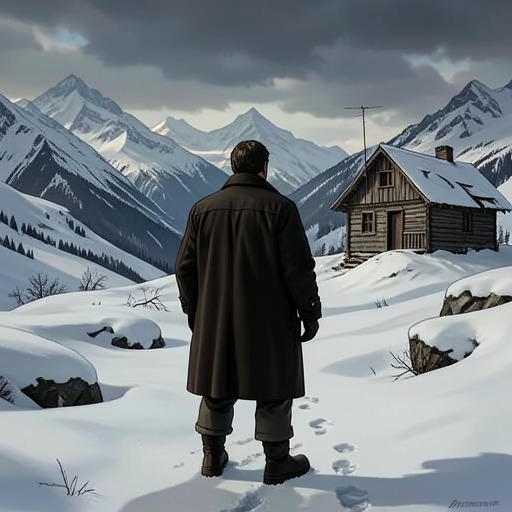
The cattle connect the village to a larger seasonal landscape. Bruno explains that his uncle and older cousins are already in the mountain pastures, and that he will join them in August with the younger cows left below. The journey to the family’s summer farmstead takes Pietro and his father about an hour along the valley track. There, three mountain huts stand above a wet, fern-covered basin and a stream; beyond it, the pastures are maintained and the path climbs into sun and drier ground. The route makes clear that tending cattle depends on moving between village and upland grazing, and that the herd is distributed across different elevations as the season advances.
On later climbs, Pietro and his father pass isolated mountain farmsteads and herds of indifferent cows. The animals are part of an active pastoral world, but they do not make the ascent gentle: the boys and men cross steep ground, nettles, and paths where dogs come growling around their ankles. The cattle are encountered amid the work and terrain of mountain life, not presented as decorative signs of an untouched wilderness. Their presence registers a landscape still being used and maintained.
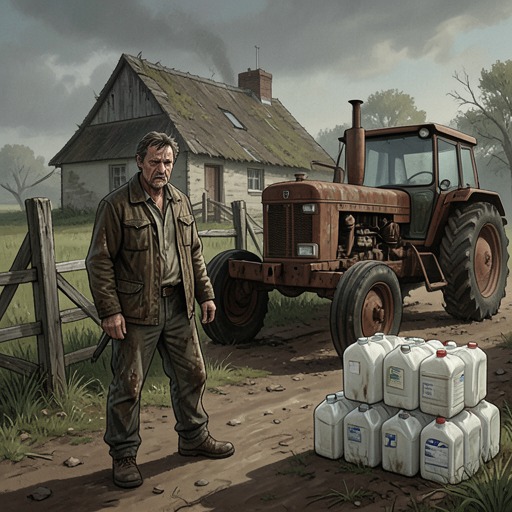
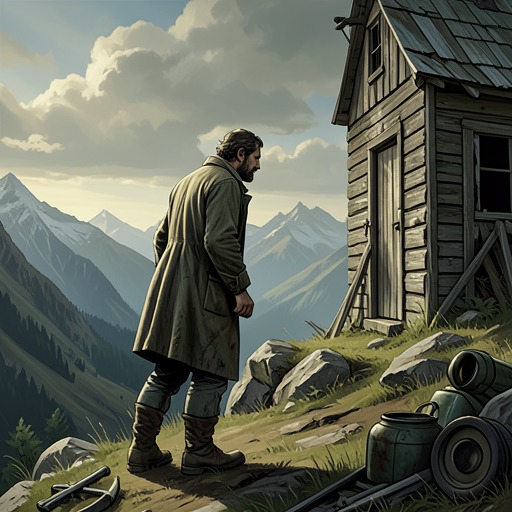
The farmstead’s material condition complicates any easy pastoral picture. Around the huts lie plastic buckets, partly rotted wood, a stove made from a diesel-oil drum, and a bathtub repurposed as a drinking trough. Inside, Bruno’s uncle and Pietro’s father discuss the number of cattle, milk production, cheese yields, prices, and regulations affecting cattle breeders. The livestock support a working farm, but the surrounding objects and the economic conversation show how little security that work guarantees. Bruno, meanwhile, takes practical tasks in hand: he lights the outdoor stove, fetches water, peels potatoes with his penknife, and prepares a meal for the group. The same competence that helps him manage everyday life is visible alongside the labor of the farm.
Labor, Value, and a Changing Landscape
For Bruno’s uncle, the farm’s economic problem is not a lack of attachment to the work. He calculates aloud that current prices and regulations make the small operation no longer economically viable, and says that he continues largely out of passion. He also predicts that within ten years of his death the land will revert to forest. Pietro, who has not considered that possibility before, looks across the grazing and imagines weeds and shrubs obscuring the drainage ditches, dry-stone walls, paths, and eventually the houses. The cattle thus mark a landscape that is neither wholly wild nor permanently settled: its open pastures depend on continued human labor, and without that labor the forest may reclaim them.
The animals also occupy two different kinds of reckoning. To Bruno’s uncle and Pietro’s father, they are counted as heads of cattle and measured through milk and cheese production. To Bruno, they are a daily responsibility; to Pietro, they are familiar companions in the geography of his summers, whether grazing below the village or scattered across upland pasture. These perspectives meet without erasing one another. The cows are living animals within a routine of care, but they are also the basis of a business whose prospects can be assessed in prices, yields, and costs.
Bruno’s Farm and Its Uncertain Future
Years later, while the two friends are rebuilding Barma, Bruno describes his plan to buy his uncle’s farmstead. He has saved money, spent it on a down payment, and hopes to borrow the rest from the bank. His months at Barma have served as a trial: he believes he can manage the work and wants, the following summer, to rebuild the huts and buy cattle, with the aim of having a farm operating within a few years. The plan extends the childhood world of the herd into an adult project. The cattle would not merely recall Bruno’s earlier life; they would form the basis of a future he intends to build through work and investment.
That future proves financially fragile. When Lara later looks back on the years before their separation, she says that once it was clear the farm could not succeed, other possibilities remained: selling the cows, renting out the farmstead, and finding employment elsewhere. She was willing to consider a more ordinary life until circumstances improved, but Bruno could not accept alternative lives. Her account makes the cattle a concrete measure of the choices the couple faced: selling them might have helped preserve a shared future, while keeping the farm meant continuing to stake that future on a venture she believed was no longer viable.
The herd’s final significance is therefore inseparable from the decline of the farm. Bruno eventually declares bankruptcy, closes the agricultural business, and hands the farm keys to the bailiff; Lara leaves with their daughter. His childhood cattle had represented work he already knew how to do, and the animals he hoped to buy for his own farm promised continuity with that experience. Yet familiarity with the labor could not remove the pressures of prices, debt, and an unviable business. Across the narrative, the cattle embody both the durable attraction of mountain life and its material limits: the pastures require their presence and the work they entail, but neither the herd nor Bruno’s commitment can guarantee that the farm will endure.